Showing posts with label plein air painting. Show all posts

Tuesday, September 11, 2018

Just Plein Fun!

Put yourself here!

I love plein air painting! I love being outdoors for hours at time, quietly absorbing the sounds and rhythms of the land I'm standing on.

Painting outdoors adds a dimension to the process of creating that's absent in the studio: the outdoors itself. Working on site, it's impossible to not become quickly aware of the many subtleties of color, line, shape and material of the  environment. All of it works its way into a painting.It's as if the place and the painter work in concert to produce the result. It's an intensely rewarding experience.

I invite you to test this for yourself at a workshop I'm teaching this month. On the 28 and 29  of September, The Eastern Shore Art Center is sponsoring a plein air workshop that I'll be teaching on the bluffs above Mobile Bay in Fairhope. I invite you to join me for two days of instruction, demos and painting. But sign up quickly! Space is limited. Here's the link.

https://esartcenter.org/product/bayview-plein-air/

I look forward to seeing you there!


Monday, August 11, 2014

Painting on the White River

On the White River

My favorite place to paint while I was in Arkansas, was at the White River tailwaters near Beaver Dam. The river is icy cold because it's flowing from the bottom of a very deep dammed lake. It's a popular trout fishing spot for that reason.The river level changes during the day with the release of water from the dam upstream. Fishermen arrive early, wearing waders despite the 95 degree heat, and pack up when the horn sounds signalling the release of water. Each day when they left, I had the river almost completely to myself. I loved the solitude and fell easily into the rhythm of painting while absorbed in the stillness of the trees and the gentle rippling of the river.

On my first day, I set up on the edge of the river and focused on the opposite bank. The river was low enough to see part of the rocky bottom. I was about a half hour into my work when the warning horn sounded. At first there was little change in the river. But gradually a sound like rapids could be heard and the current became noticeably faster. I had to paint faster too because the rocks along the bank I was painting were getting covered by water. I included the rising water in the painting. 


Water Rising 9x12 oil
©T Grillo Laird


I had such a good painting day that I returned the next day. The sky filled with clouds as I set up. I wondered if the nearly constant rain was what caused the river and surrounding woodland and even the humid air to seem infused with blue and green color.

Choosing from half a dozen possible painting subjects, I turned my easel towards the bluffs rising high above the river. I set up a 16x20 panel and began to work. My palette for both days was a range of greens, blues and browns mixed from 3 primary colors.
Once again the warning horn sounded at about 12 noon and the fishermen packed up for the day. I wasn't concerned about the rising water since I'd seen the extent of it the day before, and I had set up on a rise on the riverbank.


getting started
Soon the horn sounded again. Fifteen minutes later it sounded for a third time.My husband Pete and I looked at each other with the same question.Three horns! Does that mean it's time to build an ark? I kept working.


You can see little ripples in the water as the river started to rise.
Too  soon I heard the rustle of quickening water.I kept an eye on the river to my right as the rustle turned into a steady rush. My husband started moving excess equipment to higher ground. The river had risen less than 2 feet the day before so even if it rose higher than that, I felt I'd put enough room between me and the river's edge.
I was so busy congratulating myself for timing things right as I painted,- the river was now about a foot away- that I didn't even think to look to my left until Pete called out a warning. The water had snaked around to the left and I was now standing on a little island surrounded by an icy moat. I wasn't finished painting but the water was so close that I just started tossing everything up on the bank. I watched my water thermos float away as I hauled my easel towards the bank. I finished packing up from a high spot in the woods and assessed the day's work. Though unfinished, the canvas still gives me enough information to paint a larger studio version.


as finished as I was going to get for the day
 If I return to the area around Eureka Springs, I'll surely paint at this spot again. 

Monday, March 25, 2013

A Season of Renewal

Soon I'll be returning home after a year's absence. In this past year of  visiting home only infrequently, I've come to realize that I truly do like my Florida life. I'm excited to be getting back to painting and to the teaching I had put aside.


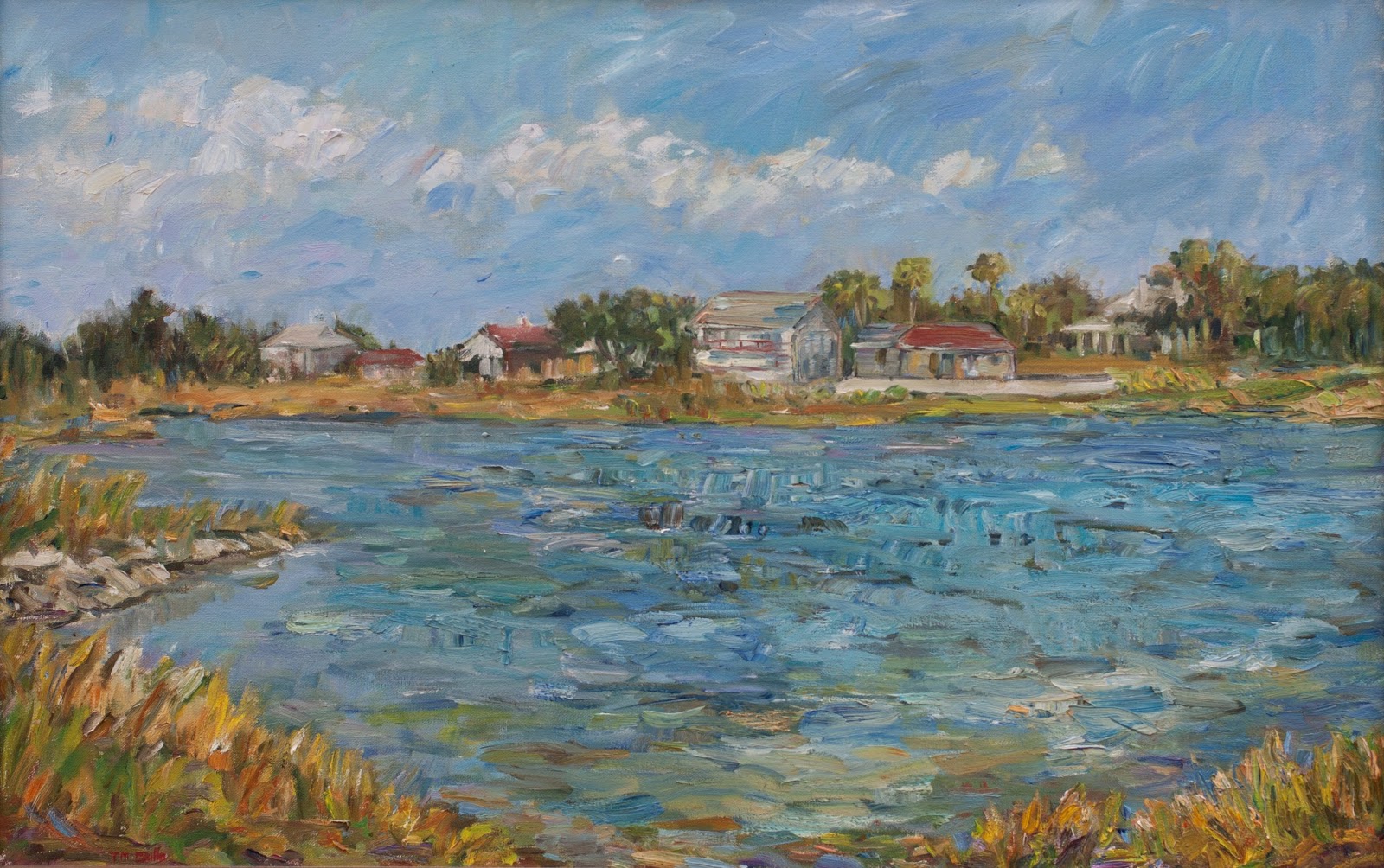
Little Sabine Bay - oil on canvas - 18x28
This painting, Little Sabine Bay, represents an earlier new start in my life that is also centered around Florida. It was the first painting I did in Pensacola, where I moved ten years ago after the loss of my life companion and painting partner. We had painted together for years often working on the same canvas. After his passing, I knew he didn't want me to stop painting, but I just couldn't pick my brushes up. Finally, a year later, I was ready. I felt like he was painting right through me as I worked. Effects appeared under my brush that I couldn't have produced for trying. Little Sabine Bay was both the first painting I did in Pensacola and the first painting I did with the  Plein Air Painters of Pensacola. I've never wanted to sell it.
Now I'm about to embark on a fresh start again with a renewed appreciation for my home and life and for this art life I've been gifted with. 

Friday, January 11, 2013

From the Back Burner - Day 10 - 30 Paintings in 30 Days

Today was one of those brown and grey winter days in the north. In the country, a day like this can be beautiful  with the shapes of bare trees silhouetted  along hill tops. But in suburbia, it's just plain dreary. It's been so dark all day, that there wasn't even a chance of photographing my day 10 painting. For day 10 of this challenge I headed out yesterday to a nearby park to work plein air. My usual method for plein air work is to work large, getting as much of the scene down as I can and returning as often as I need. Then I finish it to my satisfaction in the studio. It's a method that has worked for me since I first began plein air painting many years ago. But lately I've become dis-satisfied with the amount of time it takes to finish a work. Sometimes I even lose enthusiasm for whatever it was that inspired me in the first place. So I've started to work  more quickly entirely on site even if that means having to work smaller.There's truly no substitute for working from life. Everything is different. There are subtleties of color and light and shape that photos just don't capture. My painting which hopefully I can post tomorrow,  is a study of trees on a lake edge in the late afternoon light. The water kept changing every two minutes and each change was more interesting than the last. I finally had to choose just one option and stick with it. 

Afternoon Shadows - oil on canvas panel - 7"x 9"
Buy Now!
Buy a print of this image


Tuesday, June 5, 2012

What is a Plein Air Painting?

"Plein Air" simply translated, means painted while out in the open air.


Artists have always painted and sketched outdoors but these works were traditionally thought of as studies for larger studio work. The French Impressionists were among the first to present their outdoor works as finished pieces. Their aim was to portray modern life in all it's immediacy.

I am a plein air painter... or so I thought. I've been painting outdoors for years. So, lately I've been surprised by a new and more rigid definition of plein air and by the vehemence of those who insist on only this definition. Plein air "purists" maintain that a work has to be completed rapidly outdoors with little or no revision back in the studio.
It's interesting that past artists both here and abroad who made the plein air movement popular, never imposed that condition on themselves. They didn't find it necessary to place limitations on their working method in order to feel that their outdoor work was valid. The point was to produce the best work possible.

The plein air movement is stronger than ever today. There are legions of artists who can paint a scene in 2 hours or less and some people would argue that this ability is a sign of their talent. Often, the results are beautiful. But equally often I'm left wishing for those further touches of paint that earlier artists had no problem adding if it aided their painting. I think the unique and recognizable styles of these earlier artists is partly due to the fact that they painted as well as they could indoors and out with no thought to what critics might say about how they arrived at their results.

What do you think determines what a plein air painting is??
Related Posts Plugin for WordPress, Blogger...