Saturday, January 30, 2016

Listening to the Muse

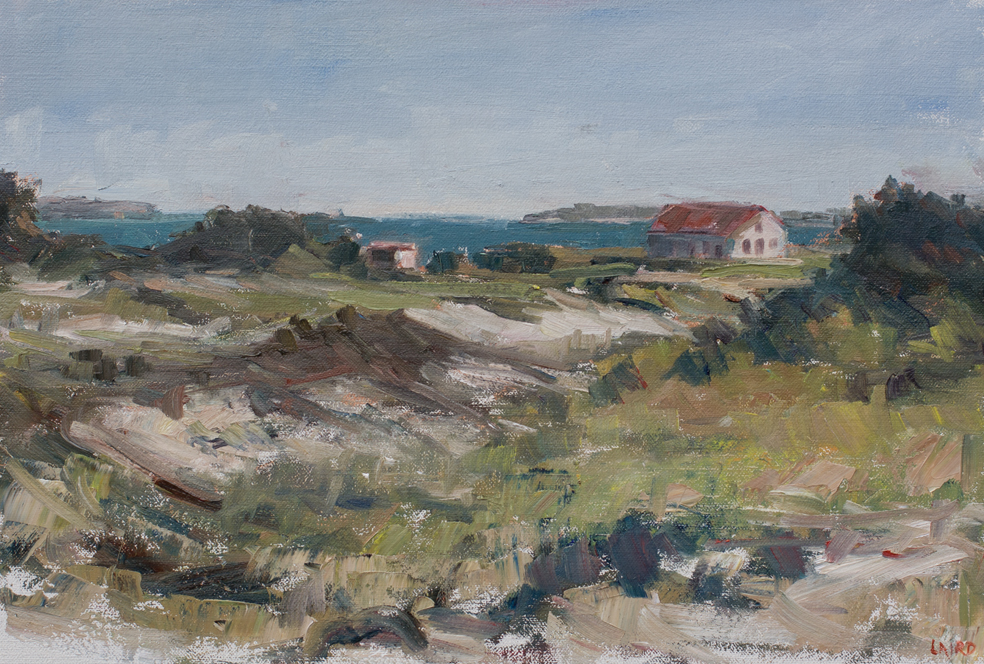
©Theresa Grillo Laird - Opal Beach - oil on canvas - 24x30
(sold)
I look at the work of other artists and I see I still have much to learn. What a trap it is when you begin to know something and you start thinking that you know most of what you need to know! 
I know intuitively when I'm not hitting the mark. I'll bet most artists do. No matter the praise, I know when the visual meets or even comes close to the sensation that's the heart of the painting. 
So, why look at the work of other artists?

Here are just a few among the many good reasons. In the isolation of the studio, it's good to look at other artist's work both past and present to remind you that you are part of  a community of artists stretching back through the ages who have left their contribution on the earth for the enjoyment of all, past present and future.

In more practical terms, you can find or create a solution to a painting problem either by seeing how someone else solved it or just by being inspired by their work to a new direction of thought.

Often, looking at other's work rekindles the fires of dreaming that can grow dim with disappointments. Whether the dream is places you want to go, or new methods to try to bring your vision into reality, you need to dream. Without dreams there's no creation.  

When isn't is beneficial to examine the work of others?
It's probably not a good idea during those times of temporary insanity when you lose all belief in your ability. The solution to that sorry state of affairs is to keep working and eventually you'll have the proof in front of you that you do know what you're doing. 
It also not helpful to search elsewhere when you're in a negative state of comparing yourself to others rather than a place of open minded exploration.

I will keep studying the work of other artists, remembering to look forward to the exciting possibilities in front of me, and not banking on painting goals already reached.

Friday, January 22, 2016

Smoke and Mirrors


©Theresa Grillo Liard - Oil on canvas - 9x12
click here to ask about this painting

I was listening to an interview on NPR today of Pete Wells, the New York Times food critic. He commented that people today are getting their culinary information predominantly from sources like Instagram. He made the point that the pictures are beautiful but a misleading impression of how food is prepared and how it would taste. By the time all the minute touches are put on the plate for the sake of the visual impact of the photograph, the food would be cold and ruined. He lamented that social media sources like Instagram or Pinterest give people who are searching for an outstanding food experience, a picture that's presented with visual impact in mind rather than an understanding of the actual taste of the dish.

I was struck by the similarity of his complaint to the world of art. It's relatively easy and even necessary for artists to create awareness of their work through social media. That also means that for anyone with enough technical savvy and enough nerve, the sky's the limit for whatever picture of their worth as artists they choose to create and present to the world. Sometimes the autobiography is accurate and just. Sometimes it's as unreal as an instagram post of an amazing dish that can only exists as a photo. 

So what's an artist to do? Shameless self promotion knowing that the buying public will always choose a product that's packaged as a winner? Or work your talents and count on the world eventually noticing a good product? 

Sunday, January 17, 2016

Around the Plein Air Lunch Table

©Theresa Grillo Laird - Across the Bay - oil on canvas
click here to inquire

I say it's high time we take back the definition of "plein air" from the multitudes of former illustrators who have hijacked it. 
"Plein Air" means painting outdoors plain and simple. No where has it ever been said - until very recent times - that you don't dare touch the painting again and that it must be finished quickly in one shot. 

Before the computer age, commercial artists had to work quickly and in a kind of painted shorthand if they expected to keep their jobs. Artists aren't bound by the same constraints. For well over 100 years artists have toiled in front of nature blissfully ignorant that the masterpieces they were turning out weren't legitimate plein air!
Imagine telling a Monet or a Redfield or Edgar Payne that they were unwelcome to exhibit or join an artist's association because their painting lacked the freshness and spontaneity that only something painted quickly in one go could have.  

Painting in front of nature is without a doubt the best way to learn landscape painting. Colors and values aren't very accurate in photos and photos completely lack the sense of air space between and around objects. Painting on the spot also gives you familiarity with the elements that a landscape might be made of. A tree isn't just any tree for example. Each tree and each kind of tree has it's own unique characteristics. The same tree will even look different under changed weather conditions. Nature is never a boring teacher!

So grab your paints and head on outside. Learn everything you can. And don't let anyone tell you that your work is less worthy because of when or where you chose to call it finished.

Monday, January 11, 2016

Who's life is it anyway?

“To award prizes is to attempt to control the course of another man’s work. It is a bid to have him do what you will approve. It affects not only the one who wins the award, but all those who in any measure strive for it.” 
― Robert HenriThe Art Spirit

Robert Henri-Tam-Gan

New Year, new beginnings, new directions...

Recently I was talking with an artist friend. The recipient of a lot of prizes and honors, he surprised me when he said he was veering away from the competition circuit, to forge his own personal path to a successful art life. We talked about how disappointing it is to see the elitism that seems to have developed among some of the award givers and recipients and how this has led to a select few who are repeatedly awarded wins even when their work is less than outstanding. While recognizing that contests and plein air events work for some artists to bring their paintings to the attention of collectors and gallerists, he decided that he is not going to rely on the subjective opinion of judges to determine his critical and financial success.

When you look at all the variables that go into judging and winning art competitions, you could drive yourself crazy looking for the answer to why some paintings win and others don't. And you can throw yourself way off course trying to change everything you do in order to be includes among the honored. I admire my friend's clear minded pursuit of the direction that means something to him personally, individually.

Before jumping on the bandwagon with the rest of the hopeful crowd, it's worth asking what artistic success looks like. You may be wasting a lot of time, money and energy on contests and accolades that don't serve you. 

It's your own personal adventure. Don't let anyone else dictate it's direction.


Thursday, December 31, 2015

Why I changed my palette

©Theresa Grillo Laird - Winter Day on Navarre Beach - oil - 12x18"
(the first venture into using a 3 color palette)

Many years ago in Mr. Wright's high school painting class, he laid out a palette of colors for a lesson on portrait painting. The idea of a set palette of colors was new to me. Until then I had just squeezed out what ever colors seemed needed for the subject. Even afterwards, I still had such a poor understanding of color options that when I went to a workshop after high school, I struggled to remember the palette thinking that it was the one and only palette that anyone ever used.

As I gained more experience, I adopted a standard all purpose traditional palette. It had a cadmium red and alizarine crimson, ultramarine, prussian and cobalt blues, cadmium yellow light and deep, yellow ochre, burnt and raw sienna and raw and burnt umber, venetian red, viridian green and terre vert. I also used sap green a lot in those days- I just plain liked the color.

The next shift in my palette occurred when I moved to Florida and began painting much more frequently en plein air. I didn't deliberately start using fewer colors. I just chose colors I saw in front of me. I had also started teaching, and  a palette of 6 to 8 colors- a warm and cool of the primaries- was easier for students to handle. 
Since from my earliest painting days, I'd used both a palette knife and a brush, the look of the paintings came from both texture and the color.

The paintings were selling and buyers especially liked the color and the texture. You'd think I'd be off and running, but I wasn't happy. The paintings seemed overly bright and it became too much of a crutch to rely on texture to create vibration in them. 

So about two years ago, I started working with much less knife work and with only permanent red, ultramarine blue and cadmium lemon yellow.
The greys that result from combinations of these three colors give the paintings a more naturalistic range of color very different from the brights of the more extended palette. Painters who advocate using a three color palette say you can get a full range of colors from them. I think it's more accurate to say you can get the appearance of a full range of colors by balancing brighter mixtures against greyer ones.

I miss the pure pleasure of looking at a tapestry of saturated colors on the canvas but I like the greater sense of color harmony that comes with the smaller palette. I still haven't decided which I like better. Lately a few of my old favorites and a couple of new colors have made their way back, mostly varieties of red that are so useful for modifying colors.

It may be so soon to know if I'm on a wild goose chase that I'll abandon like Pissarro did with his pointillist period or Renoir with his hard edged portrait work. But I'd have never been satisfied if I didn't at least try experimenting with something that might work better to make a better painting. And isn't that after all what it's all about.

Saturday, December 26, 2015

Dona Nobis Pacem

©Theresa Grillo Laird -Christmas Light
It's Christmas, the time of year when thoughts turn to peace, joy and goodwill. Yet look around and the world seems so dark. The people in our country are polarized, standing immovably on one side of the line on every aspect of life that could possibly be argued about. Shallow thought and self indulgence are celebrated, and around the world, a savage mentality has been loosed and is viciously killing supposedly in the name of God.

I've been looking around at this world I barely recognize, and trying to perceive if it's always been in such turmoil and I just didn't see it, or whether this is something new, when I heard a message at Christmas service that resonated with me. I know that all my readers may not follow Christian teachings but this message applies to all who wish to live in peace no matter what their belief.

Those gathered for the candlelight service were reminded that Christmas song and Bible verse refer to a great Light that is seen in the darkness, and a Light that darkness can never extinguish. We were reminded to look for that Light that is always there no matter how dark the night is. The sermon continued while I sat in the glow of candlelight imagining myself seeking light where there seemed to be nothing but darkness and wondering in what guise I might find it, and then came the zinger- and be that light yourself reflecting the Light that darkness can't put out. Now that's a plan for the New Year.

Peace, joy and goodwill to you this season and throughout the year!


Thursday, December 17, 2015

Santa delivers the goods


 ©Theresa Grillo Laird, Late Season Snow, oil, 12x16
Interested? Talk to me here

Santa came early to my art studio this year in the form of a finished goals list and project list for 2016! Those who know me couldn't be more surprised than I am to have this task finished 2 weeks before the new year! Yay!! Usually it remains an amorphous cloud of thoughts still floating in the cerebral netherworld halfway into the year. I must admit I can't entirely claim credit for this early Christmas gift to myself. It came about from taking Alyson Stanfield's Art Biz Bootcamp class that wrapped up last week. 

I have my goals divided into categories of Art, Business, Health, Spiritual, Personal and, since I'm her full time care giver, Mom's affairs. There are 4 projects for the year that will keep me plenty busy. One of them is an exciting project to mark the centennial year of the National Parks. More about that in a later post.

I still have to divide the list into monthly  tasks, then I'll be off and running! Now to finish my Christmas shopping!

Sunday, December 13, 2015

Is your studio equipped with one of these?

Gillian at 14
I pity the studio that isn't graced by the presence of a studio cat. I first discovered the affinity a cat has for the goings on of an art studio when I brought home a new kitten. Gillian was of course given free reign to roam the house. One day, in the throes of frustration with a painting that wasn't working, I stabbed away at the canvas with my brush and almost hit the ceiling when the canvas surface started jumping back at me.Like ping pong, this dance went back and forth for a few seconds before I realized Gillian had settled herself on the table behind my easel and was having great fun answering each poke of my brush with a poke of her own. For the next 14 years she was my constant studio companion.


Shadow and Oriental Art
My next studio cat was a much more sedate senior gentleman. I first made his acquaintance at my parents house in Florida. After a hurricane destroyed that house, Shadow briefly lived with me in a FEMA trailer before moving north to my parents new home.He came to my Florida studio late in his life, and made himself at home for the next year in a corner chair. Right about then, Kitty Cat began hanging out at my studio door.


Kitty Cat comes calling
No, I did not give him such an unimaginative name. He used to belong to the renters next door, but when they moved, he stayed behind. For the next few years he was on his own scrambling to survive while I traveled back and forth on lengthy stays up north. Each time I returned, Kitty Cat came running to greet me. Last Spring, after determining that his owners had no intention of caring for him, he became my cat. He's purrrfectly happy to hang out in my studio with me and only occaisionally complains about the choice of music!

Monday, December 7, 2015

What's on your bookshelf?

Young Girl Reading by Jean-Honore Fragonard

There are some art books I return to again and again. When looking for how- to information, I especially like the landscape painter's bible, Carlson's Guide to Landscape Painting. A lot of other artists like it too judging by how often Carlson's information is repeated in workshops and classes.It's a terrific book for someone who doesn't have much painting experience. But what I really like about it is that you can find helpful information and solutions in it's pages at any state of your artistic progress. The language in it is a little dated but that doesn't diminish it's usefulness.

Another book often recommended for landscape painters is Edgar Payne's Composition of Outdoor Painting. It has a lot of thumbnail sketches of composition options, as well as examples of faulty composition. I recently found a book from 1909 called Landscape Painting by Alfred East .It's interesting that it has some of the same descriptions of compositional devices that the Payne book does. I guess that just shows that good ideas get passed from one generation to another.


If I'm looking for technical information like what color the  pigment number for "delft blue" might be, I'll turn to Ralph Mayer's Artist Handbook or Ray Smith's New Artist's Handbook. Of course the info can be found online now but sometimes it's just handier to pull a book off the shelf.

Living the Artist Life by Paul Dorrell  and The Art Spirit by Robert Henri were two of the first books I replaced after a flood destroyed my 200- book art library. The Dorell book is both inspiring and entertaining. 

When I want to see how another artist solved a painting problem, I'll pull a few different books off the shelf. These might include books on the French and American Impressionists including the frequently neglected women artists. I also turn often to California Impressionism by William H Gerdts. A few others I like are Ilya Repin, , A T Hibbard, by John L Cooley, and for portrait and figure work John Singer Sargent by Carter Ratcliff.

Van Gogh was such an example of commitment and belief in his work, that it's interesting to try to figure out how he thought. My bookshelf has many books on Van Gogh including his Complete Letters. The last book added to that collection is Van Gogh The Life by Steven Naifeh and Gregory White Smith. What's especially interesting about this recently written book is that it makes sense of all the loose ends and the  explanations of events in his life that just didn't ring true. It's sad but a very good read.

These books are a small part of the art library that I'm slowly rebuilding. Sadly a lot of the lost art books I'd been collecting since childhood, are out of print. I still hope to replace the books on World Impressionism, Russian painters, Chinese Brush painters from before the communist era, artists from the golden age of Dutch painting, and an amazing book on Valazquez I often referred to.

So, what are your favorite art books?


Saturday, November 28, 2015

30 hours. What would you do with it?


If there's any complaint common to most of us, it's that there's not enough time. Not enough time to make art, run your art business and run your life. For the past couple of years, my own daily art practice has been interrupted with time consuming family needs. In trying to get a handle on such an unpredictable schedule, I recently calculated how much time I actually have to devote to art. Since about 30 hours a week of relief is currently in place, that's a good number to start with. 

Needless to say, these hours will have to be used wisely. It almost makes me wish I was a faster painter, but thinking and sensing my way though a painting is as much a part of the end result as any component.

It will be fun and a challenge to figure out how to carve up the 30 hours. In the past few years I've entered competitions, tried for grants, taught classes and attempted to start an art residency program. But now everything that isn't exactly in line with the goals nearest my heart, has to be discarded.  I'll probably use 20 hours to paint and 10 for business. It probably should be closer to half and half but I need to get enough paintings done for the coming year. All I know for sure us that I'll have to maintain a sharp focus. 

What would you do with big dreams and a small time budget? What would you do with 30 hours?


Saturday, November 21, 2015

What do you do with those paintings that don't work?

©Theresa Grillo Laird, A Soft Light, oil, 12 x 16"

Let's face it. Paintings pile up, and they're not all good. In fact, if your're trying something new- a new palette, a new working method, plein air instead of studio work- you probably have a lot of paintings that aren't that good. You might even have paintings from a while ago in a different style than you're now working in. Or maybe you did as well as you could at that point, but now you have greater skill. So what do you do with all these paintings that are not quite good enough to see the light of day?

First off, don't through them out. If you don't have storage space, try painting on pieces of canvas or linen taped to foam-core. If the painting is a keeper, you can always glue it to a panel.
Pieces that didn't work often have something within them that did work. These pieces can be kept as part of your reference material. They can also serve as a record of where you've come from and can silence the voices that tell you you aren't making progress.

Plein air pieces are generally ones that you don't have a big time investment in. If they have no record of anything you might want to refer to later, they can just be played with. The painting above is an example. It bears very little resemblance to the original scene. The time of day was changed as well as the width of the stream and the background.

With those paintings that you did as well as you could with at the time, it's fun to look back at them and realize that you now know how to solve the problem you were having. If you feel like working on them again, go ahead! Take a quick photo of the before, then have at it!

Sunday, November 15, 2015

Standing with France

 
an early painting by Alson Clark in France 


I was going to write this post about what to do with paintings you're less than happy with. But the horror in Paris on November 13 makes it necessary to pause in solidarity with the grieving people of France.

As artists, we're a world wide community connected, through art, with even the past and future artists. We are -all of us- also one one body of humanity on this earth. Friday's acts of savagery are against all of us who seek to live in peace and with respect for each other despite our differences.

The first thing I did on September 11 2001 after the attack on our country, was call my family members.In a world that had suddenly changed so drastically, the comfort and familiarity of family seemed the only antidote to the madness. In the weeks afterwards when the World Trade Center continued to burn, I found myself in a state of mind where painting was impossible. Creating art seemed like a trivial pursuit when so many people were dealing with overwhelming loss. It took 3 months to pick up a brush again. Later I learned that many artists had the same reaction.

Years ago, in elementary school, there was a children's magazine put out by National Geographic. I looked forward to each new edition fascinated by the articles and pictures of children in other parts of the world and eager to see how their lives compared to my own. What a joyous way to view the world recognizing the differences in other cultures but looking for the common ground! Its hard to understand how people who foster divisiveness and who promote rigid ideologies can wish to deny their own children this same joy. And how do the rest of us deal with people who can't grasp that we're all in this boat together?

My thoughts and prayers are with the people of France.


Sunday, November 8, 2015

Greater Gulf Coast Arts Festival


It's that time of year again for The Greater Gulf Coast Art Festival! I always make a point of seeing the show. The artists come from all over the US and it's interesting to see what's going on in other parts of the country. Sometimes you see something that gives you ideas to use in your own art. 

The show is exceptionally good this year. For me, the last 2 or 3 years of the festival  have been disappointing. There seemed to be fewer and fewer paintings each year and more and of the kind of thing that might have commercial application. But this year, it looks like an art festival with a lot of paintings and other creations that look fresh from the studio.


I enjoyed the work of artist David Skinner.Though he lives now in North Carolina, he grew up in California and knew many of my favorite places to paint on the coast.


I loved this work by Amy Lennard Gmelin. Each of these stone portals hold a candle or plant or some small item. The focus on the solitary element nestled in warmly colored stone seems like the perfect thing to create your own meditative environment.

With a steady rain falling now, I hope the show doesn't get rained out for it's last day on Sunday. If you're anywhere near Pensacola, it's worth a look.

Tuesday, November 3, 2015

Lost the Ability to Paint?

Sailing Lessons ©2015 Theresa Grillo Laird - 9x12 - oil on panel
contact artist to purchase this plein air piece

It happens to everyone at some time or another. Sometimes when trying something new, sometimes for no reason at all, you run into a period where your paintings just don't work. The harder you try the worse they get, until in a panic you start to think that you've completely lost the ability to paint.  

The only way past this paralyzing fear is to push through it, and even that doesn't work sometimes. Then you're left trying one solution after another, each not working and each telling you more insistently that you can't paint. 

When I find myself in this dark place, my path out is to go blank in my thinking and feelings so all the voices and agitation are silenced. In that empty space, you just proceed. And before long you'll have the proof before you that all isn't lost!

Monday, October 12, 2015

Plein Air in Bagdad

Jacobs Bayou - ©Theresa Grillo Laird - 14x18 oil
(with apologies for the iPhone photo!)
Yesterday, October 10th, was the 5th Annual Bagdad/ Milton Plein Air Paint Out in this little corner of Northwest Florida. Each year it has become bigger and better and this year was no exception.
For anyone who has never participated in a paint out, here's what happens. Some paint outs are days long and you have to compete for a spot in them. Others, like this one, are only one day long and are open to anyone. In either case, they're an excellent way to meet other artists and see a variety of approaches to painting on the spot outdoors. Paint outs are also an excellent opportunity for the public to see artists at work and to purchase the freshly created paintings. Usually there is a reception open to the public where anyone can view and purchase the works and speak to the artists who created them. Great fun all around!

relaxing after the day's painting while the show was being hung
To participate, you need to arrive prepared with blank canvases or panels, and frames to fit them wired for hanging. If you usually paint only in your studio, some supplies you might not think of are sunblock and bug spray, a hat to shield your eyes and keep you from getting a burnt scalp, garbage bag and paper towels, an umbrella that attaches to your easel to shield your canvas and paints from light and glare, and an easel substantial enough to not blow over in the wind. If you usually use an extensive palette of colors, you might want to think about paring down to make your load lighter and your palette easier to manage in rapidly changing light.
At the beginning of the event, you get your panels stamped by the organizers to ensure that no one is cheating by bringing in work that wasn't done during the event. Then you head out, pick your spot/s and start painting. The paintings are then turned in by the stated deadline and are hung and judged for prizes.

waiting for the judges decision
In yesterday's event, judged by Craig Reynolds, I was surprised and honored to receive first place! Inspiration helped since I chose a spot I've had my eye on for a couple of years.


Best of show and second place went to the same artist Mitch Mann

 Mann's low key and very effective piece of work

Third place went to pastellist Fred Myers. And sponsor's choice to Teresa Rogers.

awarding the prizes
All in all, a great way to spend an October day outdoors! Hope you can join us next year!


Sunday, October 4, 2015

Homeward Bound

Homeward Bound - ©Theresa Grillo Laird - oil 20x30 - $1500
contact here to purchase

In my last art newsletter, I wrote about coming home after many months away from home, studio and art life. That started me thinking that I was also coming home in a different sense. For a long time I've struggled with understanding the balance- for me- between pursuing artistic success on one hand, and staying true to my interior spiritual life on the other. I could never quite get the two to mesh in a way that felt right.

Why are the two aims mutually exclusive you might ask? Well, they're really not unless you start viewing the gift of your talents as a self serving route to fame and fortune. Then the fruits of your labor become driven by a desire to be known, admired, pursued and promoted by anyone who can create fame.

I like to think of art as a gift. It's a outpouring of visions that result from you having been given the gift of seeing in a certain way, and that you in turn can share with others to gift them with any one of a multitude of positive feelings.

So, the point is to become as expressive as possible of the vision before me. And with that, freed from all wrong turns, I find myself back home right where I started.

How have your "coming home" moments changed the direction of your work?

Saturday, August 29, 2015

Prospecting

Winter colors- ©Theresa Grillo Laird- oil 16x26
Interested? Ask about it here.
This painting and the one below were painted on site over a period over several days/weeks. Final adjustments were made in the studio. In fact, I didn't stop adjusting Golden Hour until last month and I started it early last fall. 
Working 90% on site and 10% in the studio is the most satisfying way for me to paint. But sometimes I'll just go out information gathering. I call it "prospecting". I never know what I'm going to find but I'm pretty sure I'll come up with something worth the time and effort.
Winter Colors is finished but it's given me the idea for a variant that I'm excited to try.
Golden Hour © Theresa Grillo Laird - 24x48 oil
Go here for inquiries.

Prospecting can do the same thing for you. You can try out an idea, a view or a palette, or just explore for whatever you might find. The next three three canvas pages are examples of this kind of information gathering.


In this late day quick sketch, I was trying for the shapes and colors of a fast moving cloud bank and the reflection of it on the Gulf water.


More of the play same here. The top left was for colors and the shape of the surf and the value of sky to sea. I had beach foliage in the sand but it was so distracting that I couldn't focus on the point of the exercise so I scraped it out. On the bottom left, I used used Phalo blue instead of Ultramarine to see if it captured the Pensacola colors any better. It did, but if I used that blue, I'd need to be sure that I wanted the harder effect that resulted.The bottom right was for shapes and colors within the clouds. I saw when I finished that I've got to be careful about the cloud values creating a stormy rather than late day effect. The top right had better sky-cloud-water values, though that's hard to see in this photo.


This last one was painted at sunset as a bank of storm clouds approached from the west. The dark clouds made the top surface of the waves an almost pea green color. Very interesting effect! Sunset colors lighting up breaks in the clouds were equally interesting. Within 20 minutes, a steady rain was falling on me and the canvas. The rain didn't stop a group of teen aged surfers who came by as I painted. They tore into the water challenging the waves and thunder with such total abandon and enjoyment, that I took that spirit away with me too as an added bonus for the days offerings.

Thursday, May 7, 2015

The Best Laid Plans...

Coastal Colors  ©Theresa Grillo Laird - 9x15 oil
see it here

Have you ever found yourself in a place where all your goals and plans for the year, so carefully formulated in January, just go to pieces? Elder care issues have brought me far from home and studio for much longer than expected. I can only very briefly leave the house, so even 2 hours for plein air painting is out.

The gears move very slowly in a day of the very elderly. Almost as soon as the duties belonging to one segment of the day have been completed, it's time to start the duties of the next segment. In the bits of time I can snatch between tasks, I've been focusing on things I ordinarily don't use my art time for. Not far from here are farmers fields in new spring green and flowering trees that I can't stop to paint, but from the house windows I see suburban backyards and small homes with roof lines that interrupt the view. Even this limited vista provides shapes that allow me to do small practice pieces of value and color. A block of western sky hemmed in by roofs and tree tops, gives me clouds to practice with daily. These quick studies are no more worth showing off than a musician's scales would be worth hearing on stage, but they aren't time wasted.

I've been using my time too studying the work of artists I like. It's interesting to me to find out what palette of colors artists use.

Beach House © Theresa Grillo Laird - 9x12 Oil
see it Here

My own palette has changed over time. After years of painting with a palette of about 12 or 14 colors, I narrowed it to 6 or 8 colors about 10 years ago. For the past year and a half, I narrowed it further to just Ultramarine Blue, Cadmium Lemon and Permanent Red. The paintings in this post were painted with that palette. I've started adding back in a few of my favorites like a reddish brown and a muted orange-red. Both of these colors are useful to vary green mixtures.
You can often determine what the palette of a contemporary artist is by looking at their workshop supply list. Palettes of past masters are a bit harder to research especially when colors are mentioned that aren't in use anymore. I have a notebook where I keep the names and palettes of artists I like. 

Finally, this time of exile from my beach and my studio, has given me time to think about where I really want to go and how I might get there. I've been discarding the routes that take me from my own personal path, and fine tuning what is left.
Who knows? Maybe my best laid plans of January really weren't what I most needed.

Water Rising © Theresa Grillo Laird - 12x16 Oil
see it Here

Friday, April 17, 2015

The Plein Air Convention- I swear I'll make it next year!

Sunshine Through the Oaks - Jack Wilkinson Smith

I wish I could be with all the artists enjoying the Plein Air Convention out in California, but I can't. Life's challenges have landed me far from home and studio without possibility of travel. So I'm consoling myself this week, studying the works of past California Impressionists.

Every time I look at early plein air paintings, I wonder what it is that makes them look so different from today's. I don't think it's the expertise. There are many very accomplished plein air painters today turning out visually stunning work. But these older paintings always make me wish I could wander into them and experience for myself what these artists saw and felt that made them so able to capture a sense of place and time with such depth. I can feel the spirit of the places they portrayed. Could it just be that they didn't hurry the piece? Or is it that the sense of community among artists they enjoyed,was especially conducive to their creative genius?

I have a thing about California Impressionism,  - the colors, the light, the dense pieces of paint so different from the more diffuse shapes of French Impressionism, the spiritually of it, the love for the land, the guileless honesty of the works.There are so many artists I could focus on, but these three works are by Jack Wilkinson Smith. His paintings of surf and rocks, full of force and vitality immediately caught my attention when I first came upon them in an art book.His home base was in southern California but he traveled throughout California painting all kinds of terrain.
I studied this next one to see what I like about it.

Deserted Corral - Jack Wilkinson Smith
All of today's plein air masters talk about the need to break up a shape into varying color temperatures.But it seems to my eye that this work, like others from this era, has a more complex pattern of subtle temperature and value changes. It leaves the viewer with more to look at on the canvas surface, without interfering with the integrity of the whole. The type of air hanging over the day is also really well depicted. Look at the difference from front to back of the painting. Notice too the way the color scheme is basically two complementaries- red and green. There are bright touches of color where a more timid painter would never place them, like on the outlines of the peaks on the left. There's plenty of variety in the colors but it's very harmonious.

Winter's Mantle - Jack Wilkinson Smith 
Here's a snow scene with the complementary color scheme of blue and orange. Even the greens in it are turned towards orange or blue.Look at how the singe bright spots of color, as well as the zig zag lines, bring the eye right back into the mountain peak.There's a single spot of bright orange in the middle of dull orange on the bush to the right. Above and slightly to the left, the tree top and tree trunk are lit up - the only lit up tree trunk in the whole scene - Next there's a spot of bright green in the tree tops in the center back, and finally the sun lit plane of snow on the peak. The energy of the brushstrokes fills the whole painting with a feeling of movement and nature's  sounds.


If your tax refund will put a bit of spare change in your pocket, all three of these paintings are available at Bonhams spring auction of California and Western Paintings on April 28th.

Friday, March 20, 2015

Who Are You Painting For?

Golden Hour -©T Grillo Laird -  oil on canvas - 24x48
click here for website


I entered this painting in a competition for a national exhibit. It did not get in. I had the chance to submit two paintings for consideration, but only entered the one. I had a second painting ready but didn't enter it because I thought the first was better. Not long after, I posted both paintings on Facebook. The painting I didn't enter, quickly racked up 260 "likes" and sold the next day. The one I entered in the competition, the one I thought was better, received 105 likes.

So, what does this tell me? Are competition entries more likely to be successful when they have greater popular appeal? Was it self defeating to enter only one? Am I a poor judge of my own work?? 

Then I started to think. Who am I really painting for? Whether for galleries, judges, or the writers of articles who can make an artist's reputation, I'd have to tailor the work- even if only subconsciously- to what I think would meet their expectations. What then happens to exploration and the quest to strive for the highest level and the excitement of discovery that comes with freedom from anyone's expectations- including my own?

I recently attended a workshop where one of the participants plied the instructor with questions about various marketing tactics. He listened, then quietly said "If the work is good, people will take notice." In the silence that followed, I could see my way forward.

Sunday, March 1, 2015

Painting From Photos

Though 99% of my work is painted outdoors, there are times when painting on site is impossible. Traveling with non painters or with people who are anxious to get from point A to point B in the fastest way possible, usually means I need to take a photo if I want to preserve an image I wanted to paint. It amazes me that such travelers fail to realize what unexpected treasures they miss in their single minded focus!

Here's a 24x36 I started from a photo during this past week. Though I have paintings waiting that were started on the beach and need  to be finished, wind, rain and cold kept me out of the dunes all week. This one still has a long way to go.


And here's the photo reference I started from.


I knew I wanted a yellow sky reflecting into the water, yet I didn't want anything in the background to overpower the boats. I'll see how it all evolves and if I succeed with it.

Photos can be an exciting resource when used as a jumping off point. They're also useful for unfamiliar details. But copying a photo verbatim as a standard practice, cheats the painter of the experience of seeing all the subtle color shifts and experiencing all the intangibles that find their way into a painting done on site. 

Sunday, February 15, 2015

Staying True

Footprints ©T Grillo Laird - oil 18x24 -sold

Here is a painting I completed a few weeks ago. It's popularity since I posted it, has surprised me. The first surprise was when it sold the morning after I posted it. I then posted it on an artist's site and was taken by surprise again by how well it has been received. 

I tried to analyze it. Is it the title? The colors? The mood? The paint? Then it occurred to me that in painting it, I held true to the working method that for me seems to produce results closest to what I was aiming for. Ignoring all conventional wisdom and restrictive rules about how outdoor painting is practiced, I just painted in the way I've done outdoor paintings for the past 20 years. I took my 18x24 canvas out to the dunes near my house and looked and painted. When the light changed, I packed up and took it out again the next day. And the day after that. One day I didn't like the results and scraped it all down just to begin again on my next session in the dunes. When I was finished I took it home and studied it. I made a few adjustments where a line was too strong or a spot in the background wasn't receding enough. I studied it some more then called it done. Of course no painting is ever done. It's just brought to a point where it can be left alone.

I do enjoy painting those loose sketchy paintings that I start and finish in one two hour session on site. The results are often fresh and unexpected, but most of the time I'm left wishing I had developed an idea a bit further.

I think that when I manage to shut out all the clamorous voices telling me how I must paint, and I listen to my own inner voice, I am again the happy serene painter I started out as when I was a young child.
Related Posts Plugin for WordPress, Blogger...